Smart Farm Drones
Finnegan Flynn
| 23-04-2026
 · Science Team
Imagine farmland managed not by guesswork, but by real time data and intelligent systems. Across the world, agriculture is shifting toward smarter tools, and drones are becoming an essential part of this transformation.
We are now seeing farming move beyond traditional methods. Instead of relying only on manual observation, we use aerial technology to understand crops, improve efficiency, and support more sustainable production. This change is reshaping how we interact with land and food systems.
Precision Crop Care That Boosts Efficiency
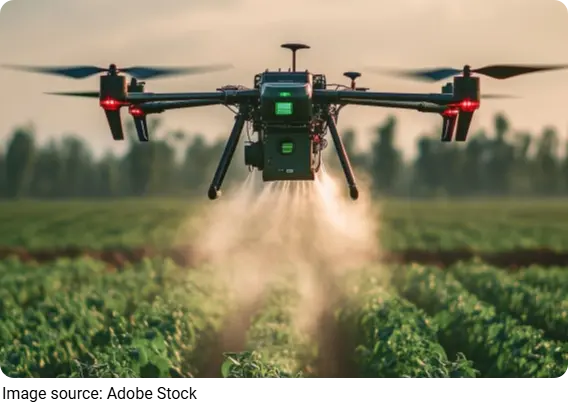
One of the most important roles of drones in agriculture is precision crop care. We can equip drones with advanced spraying systems that deliver treatments exactly where they are needed.
Compared to traditional methods, drones can greatly improve efficiency and reduce unnecessary use of materials. They also help ensure more uniform coverage across large fields, which leads to healthier crop development and more consistent yields.
At the same time, this approach supports environmental protection by reducing excess spread into surrounding areas.
Smart Monitoring for Healthier Crops
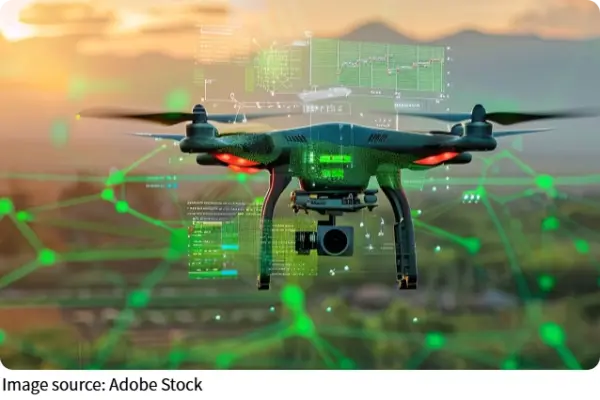
We also use drones for crop monitoring. With multispectral and high resolution sensors, drones can capture detailed information about plant health, moisture levels, and nutrient distribution.
This data is converted into digital field maps that help guide farming decisions. Instead of treating entire fields the same way, we can adjust care based on actual conditions in different zones.
This makes farming more precise, reduces waste, and helps improve long term soil performance.
Efficient Seeding and Nutrient Application
Drones are also widely used for seeding and nutrient application. With high accuracy positioning systems, they can place seeds and fertilizers exactly where they are needed.
This reduces overlap and missed spots, making field work more consistent and efficient. In many cases, drones can complete tasks in a fraction of the time required by manual methods.
By adjusting application based on crop conditions, we can also improve resource efficiency and support more balanced plant growth.
Fast Response in Changing Field Conditions
Agriculture often faces sudden changes in weather and field conditions. Drones help us respond quickly by providing real time aerial images of farmland.
This allows us to assess situations such as flooding risk, dry soil conditions, or crop stress in a short time. With this information, we can take faster action to protect crops and reduce potential losses.
This speed and flexibility make drones a valuable tool in modern farm management.
Advanced Management in Aquatic Farming
Drones are also used in aquatic farming environments. With imaging systems, they can monitor water quality, observe activity patterns, and scan large areas quickly.
They help improve operational efficiency by reducing the time needed for inspection. In feeding management, drones support more even distribution, helping maintain balanced conditions across different zones.
This improves both efficiency and environmental control in water based farming systems.
Rapid Growth of Agricultural Drone Technology
Globally, agricultural drone technology has expanded rapidly. Hundreds of thousands of units are now in operation worldwide, covering vast areas of farmland every year.
Modern drones are more powerful than earlier versions. They can fly longer, carry heavier loads, and operate with higher accuracy. Advanced navigation systems allow them to follow precise routes while avoiding obstacles automatically.
At the same time, their environmental benefits are becoming clearer, including reduced resource use and improved sustainability in large scale farming.
The Future of Connected Farming Systems
Looking forward, drones will become part of fully connected farming ecosystems. They will work alongside smart machines, irrigation systems, and data platforms to support automated agricultural operations.
With the development of artificial intelligence, sensor networks, and communication technologies, drones will become even more intelligent. We will be able to manage planting, monitoring, and maintenance in a more unified system.
This integration will also expand their use across different types of agriculture, including orchards, plantations, and specialty crop production.
Challenges That Still Need Attention
Even with strong progress, several challenges remain. Battery performance, flight endurance, and adaptability in complex environments still require improvement. These technical limitations must be addressed for broader adoption.
Another challenge is knowledge and training. Some users are still unfamiliar with drone based systems, which can slow adoption. Better education and support will be important for wider use.
In addition, clear operational guidelines and management systems are needed to ensure safe and efficient usage.
A Smarter Global Farming Future
Lykkers, smart drones are reshaping agriculture worldwide. We are moving from experience based farming toward a data driven system that is more precise, efficient, and sustainable.
This transformation is not just about technology. It is about building a smarter relationship between people, land, and food production.
As innovation continues, we will see agriculture become more connected, more intelligent, and more responsive than ever before. We are only at the beginning of this global shift toward smart farming.
Farming Revolution: How Drones Are Transforming Agriculture 🚀
Video by Farm Smart with Vinmak