Our Galaxy, Measured

Antonio
| 20-09-2026
 · Science Team
Hi, and thanks for joining us. You probably know we live inside a galaxy, but the word "galaxy" stays pretty abstract until you try to wrap your head around actual numbers.
The Milky Way isn't just big. It's the kind of big that breaks your everyday sense of scale, the way a highway mile feels trivial next to a light-year.
Why the numbers feel unreal
The disk of the Milky Way stretches about 100,000 light-years across. One light-year alone is roughly 5.88 trillion miles, so you're already dealing with distances that make the Earth-to-Sun trip of 93 million miles look like a stroll to the corner store. If you tried to drive across the galaxy at highway speed, you'd need around 100 billion years. The universe hasn't even been around that long.
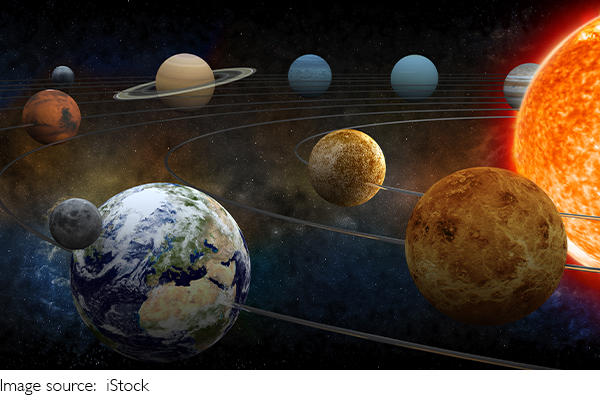
The sun's quiet neighborhood
You sit about 26,000 light-years from the galactic center, out in the Orion Arm, a modest spiral segment between larger arms. That's not a random detail. Our solar system orbits the center at roughly 450,000 miles per hour, yet one full lap takes about 230 million years. The last time we completed a full orbit, dinosaurs were just getting started on Earth. So every time you finish a year, you've actually traveled about 4.5 billion miles through space without feeling a thing.
Where the mass actually lives
The visible disk holds roughly 100 to 400 billion stars, but that's only part of the story. Most of the galaxy's mass sits in a dark matter halo, an invisible sphere that extends maybe 1.5 million light-years out, far beyond the bright spiral you see in photos. Astronomers measure this by watching how stars and gas move at the galaxy's edge. They move faster than visible matter alone can explain, which means something massive and unseen is pulling on them. That halo is why the Milky Way isn't just a disk. It's a sphere of influence that reaches toward our neighboring galaxies.
Seeing it from the inside
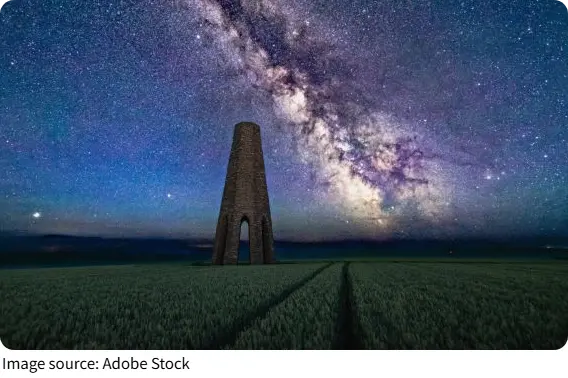
You can't step outside and photograph the whole thing, but you don't need to. On a clear night away from city lights, look toward the constellation Sagittarius. That faint, milky band stretching across the sky is the plane of our galaxy seen edge-on, and the densest glow near Sagittarius points directly at the galactic center. Binoculars will show you clusters of stars packed together, like the globular cluster M22, which sits about 10,000 light-years from us. Telescopes reveal more, but even unaided eyes get the core idea: you're looking at the inside of a structure so vast that the light from its far side takes 100,000 years to reach you.
Putting it in perspective
If you shrank the entire galaxy down to the size of Earth, our solar system would be smaller than a grain of sand. The nearest major galaxy, Andromeda, sits about 2.5 million light-years away, which means the gap between us and Andromeda is roughly 25 times the width of the Milky Way itself. That emptiness is real, but it's not empty. It's filled with stray stars, gas, and the gravitational ties of the Local Group, the small cluster of galaxies both of us belong to.
So next time you glance up at that pale band of light, remember this: you're not looking at a distant object. You're looking outward through your own home, from a suburb 26,000 light-years out, on a disk that takes 230 million years to spin once. That's not a metaphor. That's your address.