Planets Without Ground

Adrian
| 20-09-2026
 · Science Team
Welcome, everyone. You look up at the night sky and assume every planet is a place you could eventually stand on.
That's the natural guess. But it's wrong for more than half the planets in our own solar system.
Jupiter, Saturn, Uranus, and Neptune have no ground beneath their clouds. If you tried to land a spacecraft on Jupiter, it would just keep sinking into thicker and thicker atmosphere until pressure crushed it.
Rocky worlds versus gas giants
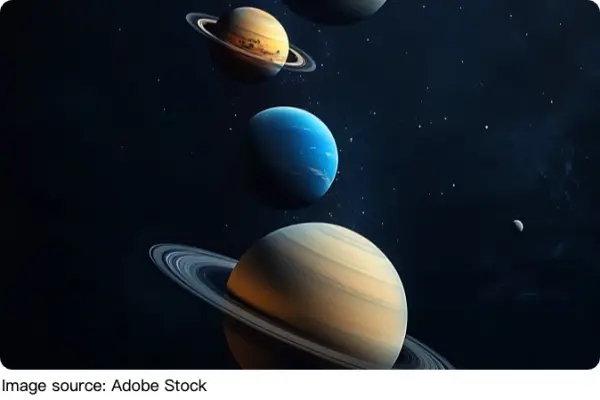
The four inner planets, Mercury, Venus, Earth, and Mars, all have solid surfaces because they formed close to the young Sun, where heat kept lighter gases like hydrogen and helium from condensing. Only heavier materials, rock and metal, could stick together there. That's why Earth has a crust you can walk on and Mars has dusty plains where rovers like Curiosity drive around. Farther out, past the asteroid belt, temperatures dropped enough for vast amounts of hydrogen and helium to accumulate, and those worlds grew enormous without ever forming a hard outer layer.
What gas giants actually are
Jupiter is mostly hydrogen, but don't picture it as a giant balloon. Deep inside, the pressure becomes so intense that hydrogen turns into a liquid metallic state, a form you never encounter on Earth. There's no moment where you cross from sky into ground. It's a gradual transition from thin gas to thick gas to liquid, all the way down to a possible rocky core about 10 to 20 times Earth's mass. Saturn works the same way, though it's less dense overall. In fact, Saturn's average density is lower than water, so if you had a bathtub big enough, it would float.
Ice giants are a different beast
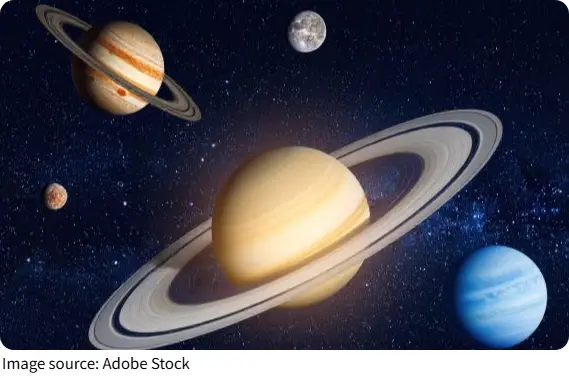
Uranus and Neptune look like gas giants from a distance, but astronomers group them separately because their chemistry differs. Instead of being dominated by hydrogen and helium, they're mostly made of water, methane, and ammonia ices. That's why they're called ice giants. Neptune's blue color comes from methane in its upper atmosphere absorbing red light. Beneath those clouds, pressures and temperatures create a super-hot, super-dense fluid that scientists call an ice mantle, though it's nothing like the ice in your freezer. Voyager 2 flew past both in the 1980s and measured winds on Neptune exceeding 2,000 kilometers per hour, the fastest in the solar system, all happening on a world with no surface to slow anything down.
Why the difference matters
This isn't just a trivia fact. The presence or absence of a solid surface shapes everything about a planet, from its weather to its magnetic field. Earth's solid core and mantle help generate a magnetic field that shields us from solar radiation. Jupiter's metallic hydrogen layer does the same job, but it's thousands of kilometers thick. On a rocky world, volcanic activity can recycle carbon and keep the atmosphere stable. On a gas giant, there's no geology in the usual sense, just fluid dynamics on a planetary scale. Even the search for life depends on this distinction. Scientists like those working on NASA's Europa Clipper mission look at icy moons with subsurface oceans because a solid surface alone doesn't guarantee habitability, but a stable liquid water layer under ice might.
So next time someone says we're going to "visit" Jupiter, remember that visiting and landing are two completely different tasks. You can fly through Jupiter's clouds and take measurements, but you'll never plant a flag on it. That's okay though. The mystery of what lies beneath those swirling bands is part of what keeps astronomers like me staring at data for hours. And the more we learn about worlds without surfaces, the more we appreciate the thin, fragile crust we happen to call home.